Category: Reviews

  • An Evidentia Success Story from Russ Worthington

    An Evidentia Success Story from Russ Worthington

    Our friend Russ Worthington — some of you know him as DearMYRTLE’s “Cousin Russ” — has been using Evidentia Software for many years.

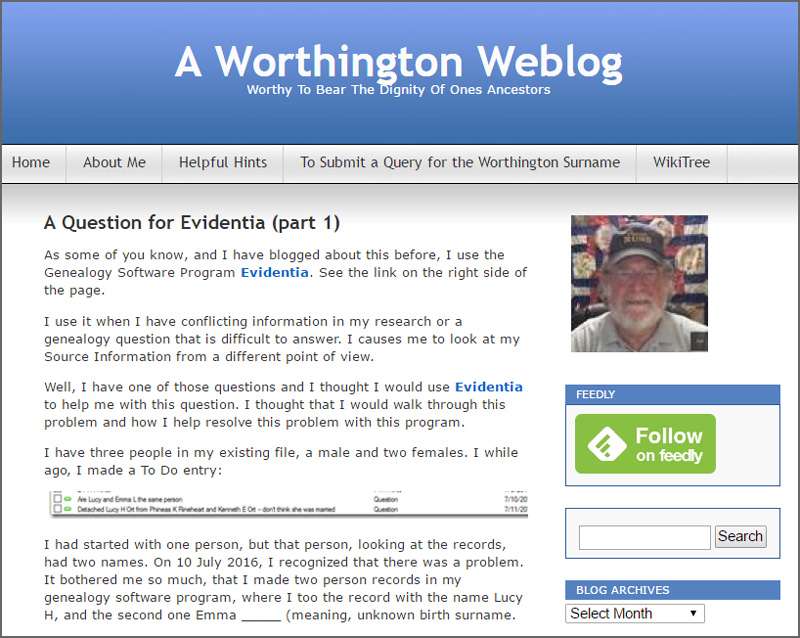
    Author of the popular blog A Worthington Weblog, he has recently completed a 7-part series titled “A Question for Evidentia,” in which he uses Evidentia Software to determine whether two women in his database are actually the same person.

    Why does Russ use Evidentia?

    “I use it when I have conflicting information in my research or a genealogy question that is difficult to answer. I causes me to look at my Source Information from a different point of view.”

    You can read Russ’s posts beginning with Part 1, or with Part 7 – Follow Up, in which he gives a re-cap of his research process, as well as a listing of all of the posts in the series. In Part 6 – Conclusion, he provides links to his completed Proof Reports, which show the result of all of his hard work.

    Many thanks to Russ for this wonderful demonstration of how he uses Evidentia Software! 🙂


  • Mind Maps

    Mind Maps

    We interrupt our regularly scheduled program…

    Evidentia is one of many tools I use in researching my family tree.  Today I want to talk about a different tool – Mind Maps.

    Ron Arons, who some of you may know from his Black Sheep Blog and from genealogy conferences, has published a new book, Mind Maps for Genealogists.  I picked up a copy at NGS 2014, and offer this review.

    Google “mind maps” and you will find tons of articles on the topics.  Search for “mind maps genealogy” and you will see the potential synergy between the two topics.  Mind mapping offers a creative way for the researcher to visualize questions and possible paths to finding the answers.

    1280px-MindMapGuidlines.svg

    Mind Map Image courtesy wikipedia.com

    What Ron does in Mind Maps for Genealogists is bring the two topics together in a clear and easy to understand format, then applies mind mapping techniques to real research problems.

    The book leads the reader to a basic understanding of mind mapping principles.  It then introduces the reader to  a few free mind mapping tools, and teaches the reader how to use those tools.  Along the way Ron points out a few mind mapping pitfalls (DON’T try to build a family tree with a mind map – you CAN, but there is little value)
    That’s right, I said FREE mind mapping tools.
      

    The book includes several case studies, showing how a researcher can break down brick walls using mind mapping techniques.  This was the part of the book that made mind mapping real for me.  I had a basic understand on mind mapping techniques having seen them used in business.

    I have long felt that mind mapping would be particularly helpful in doing FAN (Friends, Associates, Neighbors) research.  Mind Maps allow me to harness a creative thought process; Ron Aron’s Mind Maps for Genealogists gives me the information I need to make this happen.

    (Now I just need the time!)